Payment Checklist for Texas Contractors
Use this job-start checklist to capture contracts, payment terms, notices, and lien dates before a past-due invoice becomes a crisis.
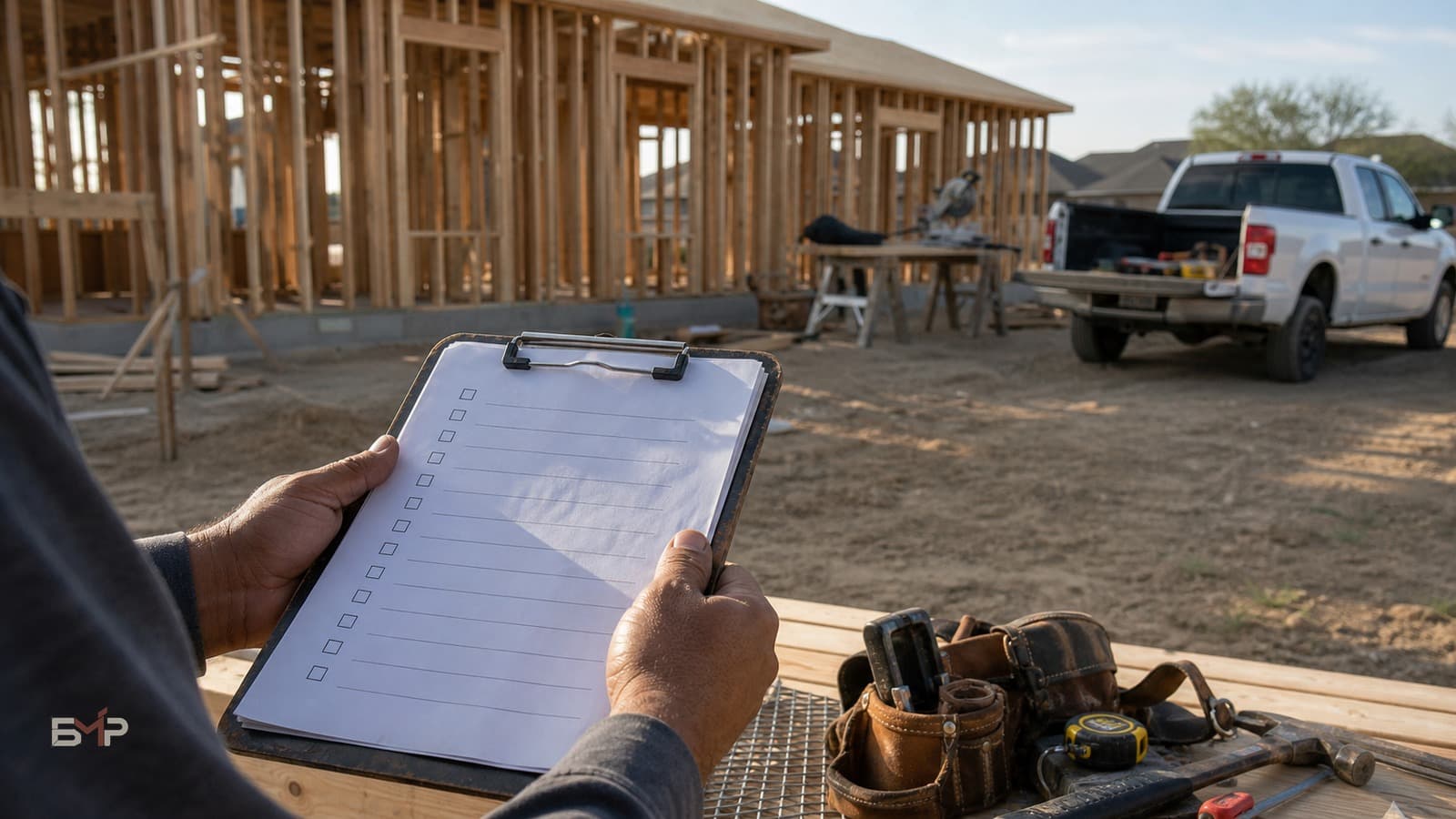
Why the start of the job decides whether you get paid
Almost every payment fight is lost at the beginning, not the end. The dispute that blows up in month three was made possible in week one — by a scope nobody pinned down, a change nobody wrote, a deadline nobody knew. By the time the money's late, you're trying to win an argument with no evidence. The checklist exists to make sure the evidence is there before you ever need it. Get these things in place at the start and most payment problems simply never get the chance to form.
The Payment-Protection Checklist
Before you start the work, make sure you have — and have recorded — all of this: 1. A signed contract. Not a handshake, not a text. The terms, in writing, agreed to. 2. A clear, written scope. Specific enough that "I thought that was included" has no room to live. 3. A payment schedule with real dates. Deposit, progress payments, final — when each is due, in writing. "At the end" is not a schedule. 4. Owner and/or GC contact and info. Who's actually paying you, and how to reach them — the payment chain, on the record. 5. Your change-order method, agreed up front. Decide now how changes get approved, so there's no debate later. (No write-up, no extra work.) 6. Invoices ready to go, with backup. Know what each invoice will include and what proof it'll carry, so it's approvable on sight. 7. Photos and delivery proof. Document conditions and materials. Pictures end arguments. 8. Your lien calendar. Know the key Texas dates for this job now — not when you're already in trouble. (And keep an attorney's number handy for the actual filing.)
The checklist only works if it lives somewhere
Here's the catch that trips people up: a checklist scattered across a truck console, three apps, and your memory isn't protection — it's a to-do list you'll lose. The power comes from having all eight things in one place per job, where you can actually see them and where nothing falls through a crack. A signed contract you can't find when you need it might as well not exist. The point isn't just to gather these things once; it's to keep them connected to the job, all the way through.
How BuilderMaxPro helps
If you want one place to keep all of this — the contract, scope, schedule, contacts, change orders, invoices, photos, and key dates, connected to each job — that's exactly what BuilderMaxPro is for. But honestly, the checklist matters more than the tool. Run it however you run it. Just run it every single time, because the contractors who never get stiffed are the ones who never start a job without it. (If you do want it all in one spot, BMP is free to start in your browser.)
Frequently asked questions
This is a lot for a small job. Do I really need all eight?
The bigger the job, the more all eight matter — but even on small ones, the signed scope, the dated payment schedule, and the change-order rule prevent the vast majority of disputes. Scale the formality to the job, but never skip those three.
What's the one item contractors skip most?
The lien calendar. People put off learning their key dates until they're already in a payment fight — by which point the most important deadlines may have passed. Capture the dates at the start, while you still have all your options.
Do I need software to do this?
No — you can run the checklist with paper and a folder. The only real requirement is that everything for a job lives in one place you can actually find. Tools like BMP just make "one place" automatic instead of something you have to maintain by hand.